BehMon

API & integration

Network data, inside your own workflow

A monitoring platform should not be an island. BehMon has a documented, stable API, two ready SDKs and signed webhooks, so your own systems can see what the panel sees.

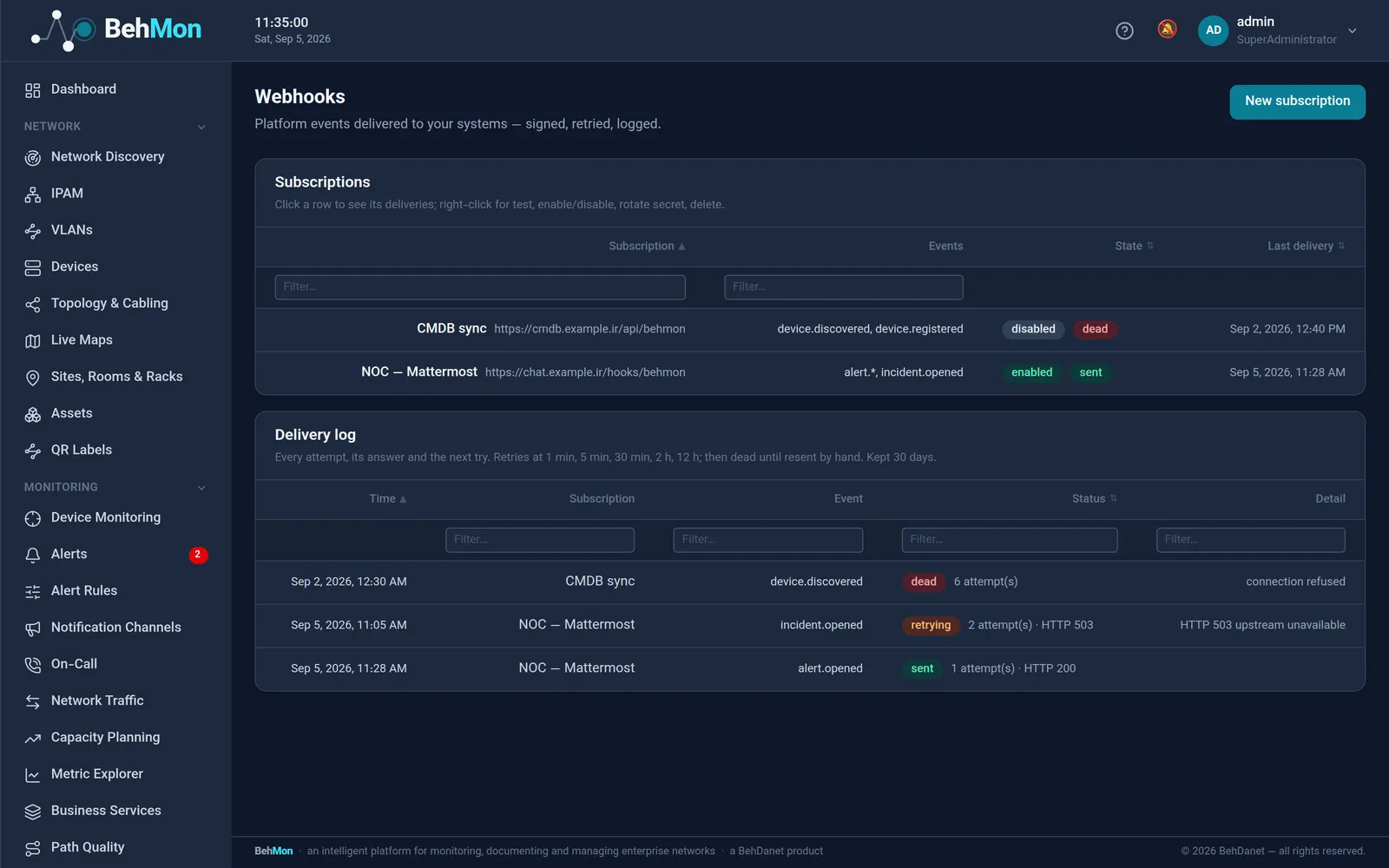
The BehMon webhooks page with subscriptions and delivery history

One API, one base URL, one contract

Every service is reached through one gateway, and one published OpenAPI document covers them all.

  • The v1 rule is add-only: removing or retyping a field fails our own build pipeline
  • Personal API keys with a scope and a per-minute request budget
  • A trace id on every response, to find that one request in every service's log
  • Every release note ends with what was added to the API
Two ready SDKs

Install a library instead of writing a client; both are generated from the same spec, so they can never drift from it.

  • Python and TypeScript, one method per operation
  • API-key or login auth, with the token refreshed for you
  • Errors with a code and a trace id, not raw text
  • Examples for the usual jobs

Signed webhooks for every event

Rather than polling the API, let the platform tell you.

  • A catalog from alerts opened and resolved to devices discovered, config drift, compliance violations, automation runs and logins
  • Subscribe by glob (all alert events, say) and filter on fields
  • Every delivery carries an HMAC-SHA256 signature and a timestamp, so the receiver can prove it came from us
  • Six retries over twelve hours, a 30-day delivery history with the response code and body, manual re-send, and secret rotation

Into the systems you already run

Standard outputs your security and support teams already use.

  • Syslog/CEF for a SIEM
  • Alerts wired into your ticketing system
  • A Prometheus endpoint and a provisioned Grafana dashboard
  • PDF and Excel for scheduled reports

Frequently asked questions

Will the API break on a later release?

No. The v1 rule is add-only: removing or retyping an operation or a field fails our build pipeline unless it is explicitly recorded with a reason, and every release note lists the API changes.

How do we get alerts into our own system?

A webhook is the simplest route: register a URL, pick the event globs and take the secret. Every delivery is signed so you can prove it came from us, and a failed one is retried six times over twelve hours.

See your own network in BehMon

Book an online demo, or install the 30-day trial on your own server. Our engineers will be right there with you.