
A separate permission, not a reduced one
A customer holds a role of its own, and only the portal endpoints accept it. No operator endpoint answers to it — which is the only way to be sure one customer never reads another's switch inventory.
Customer portal
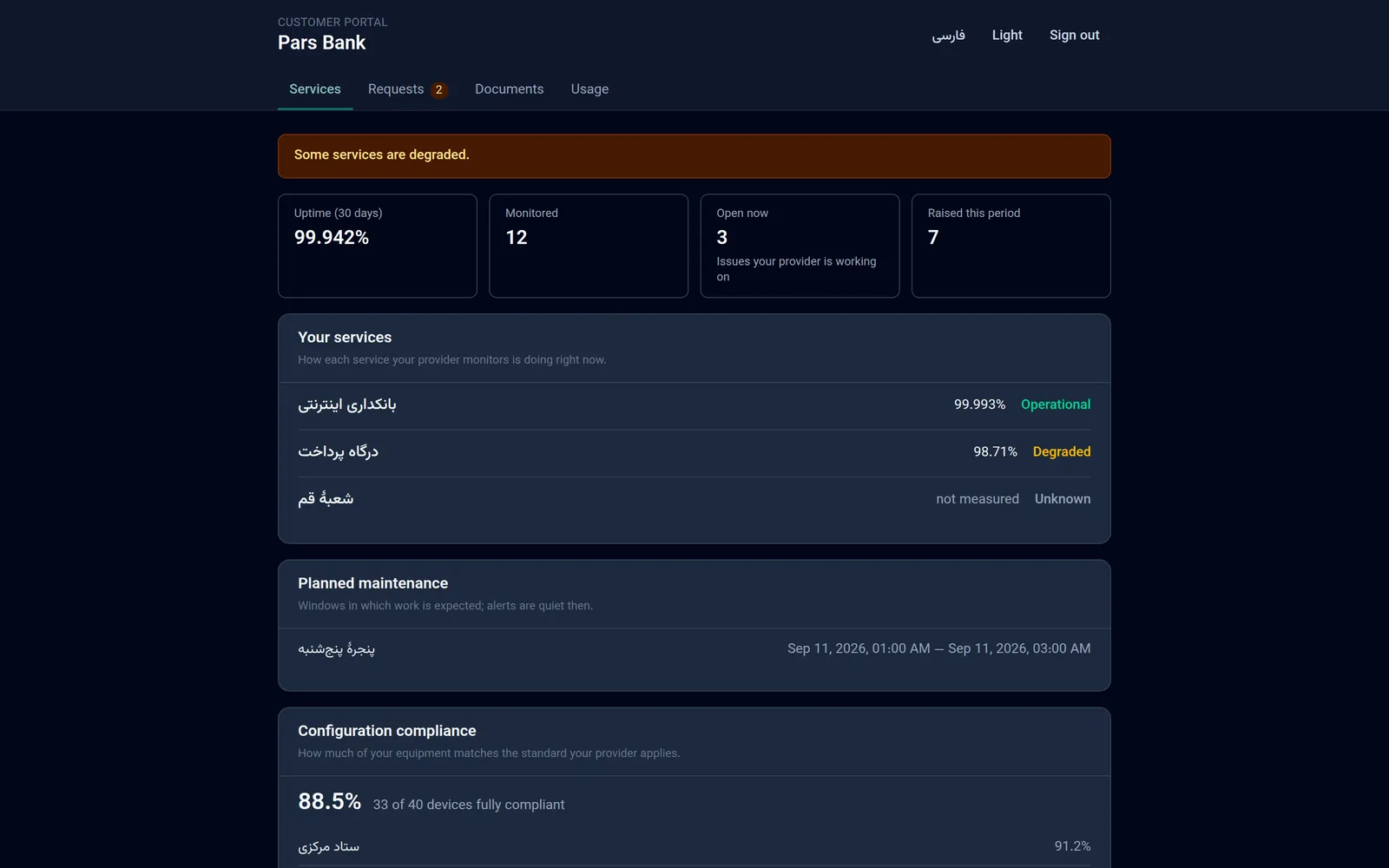
If you maintain the networks of several organisations or branches, the hardest part is proving the work. The portal shows a customer the same data your team sees, in a form that is safe to share and possible to read.
A customer holds a role of its own, and only the portal endpoints accept it. No operator endpoint answers to it — which is the only way to be sure one customer never reads another's switch inventory.
The portal is about “internet banking” and “the payment gateway”, not about core-sw-01.
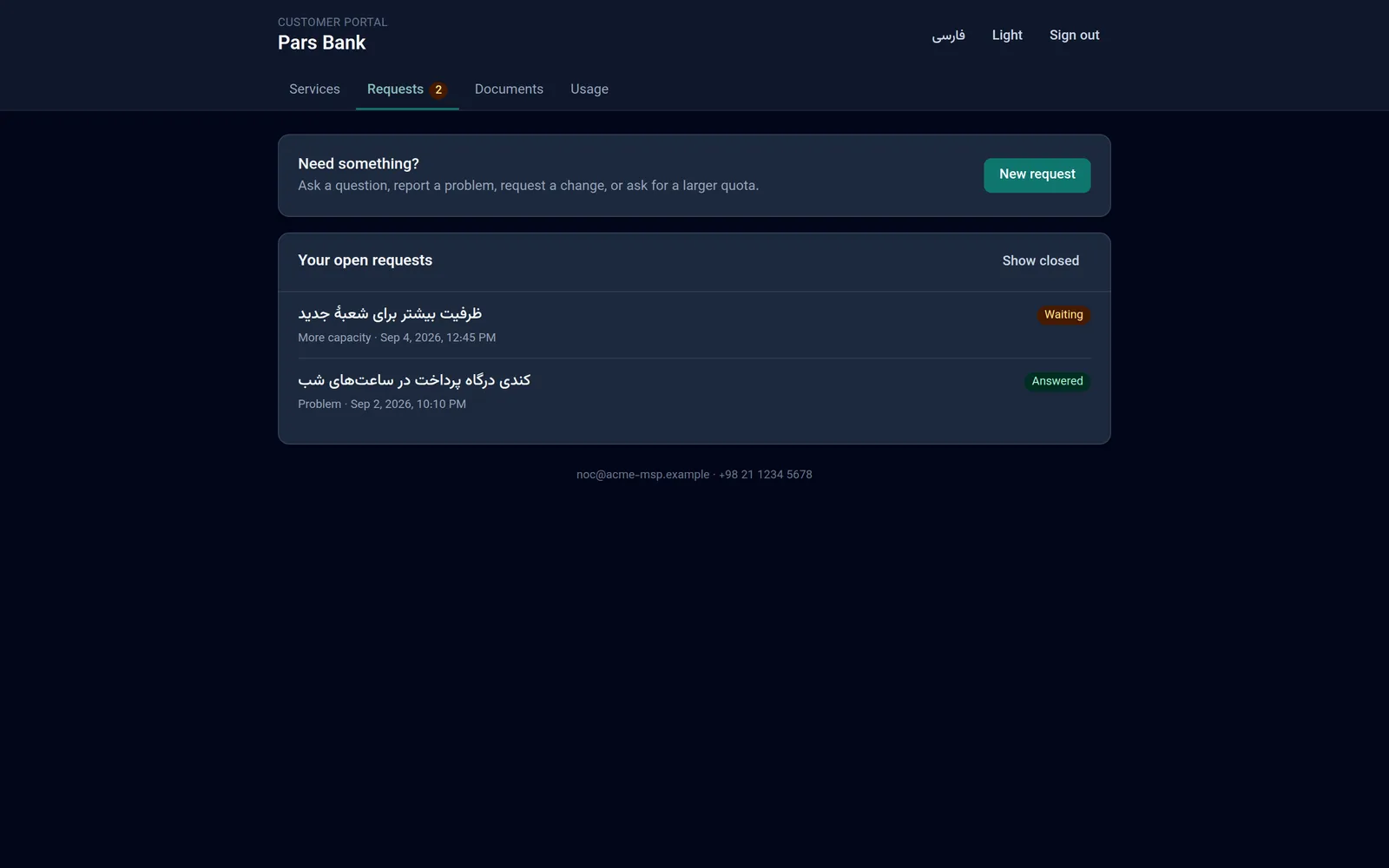
The things a customer normally chases by email are on one page.
No assignment, no SLA clock — technical alerts still go to your own ticketing system.
Each organisation's logo, name and colour go on the portal, the sign-in page, the public status page and even the letterhead of the documentation reports.
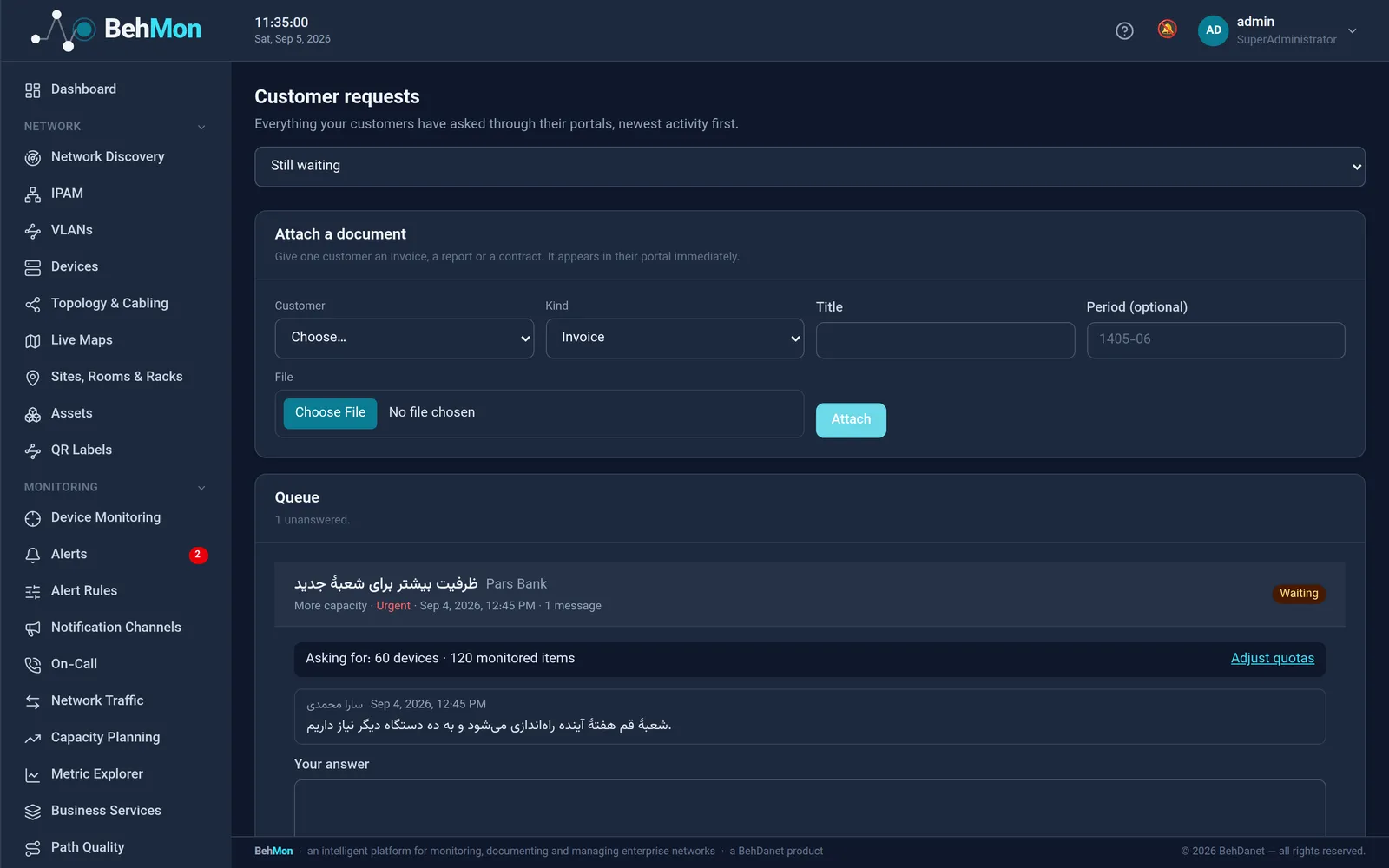
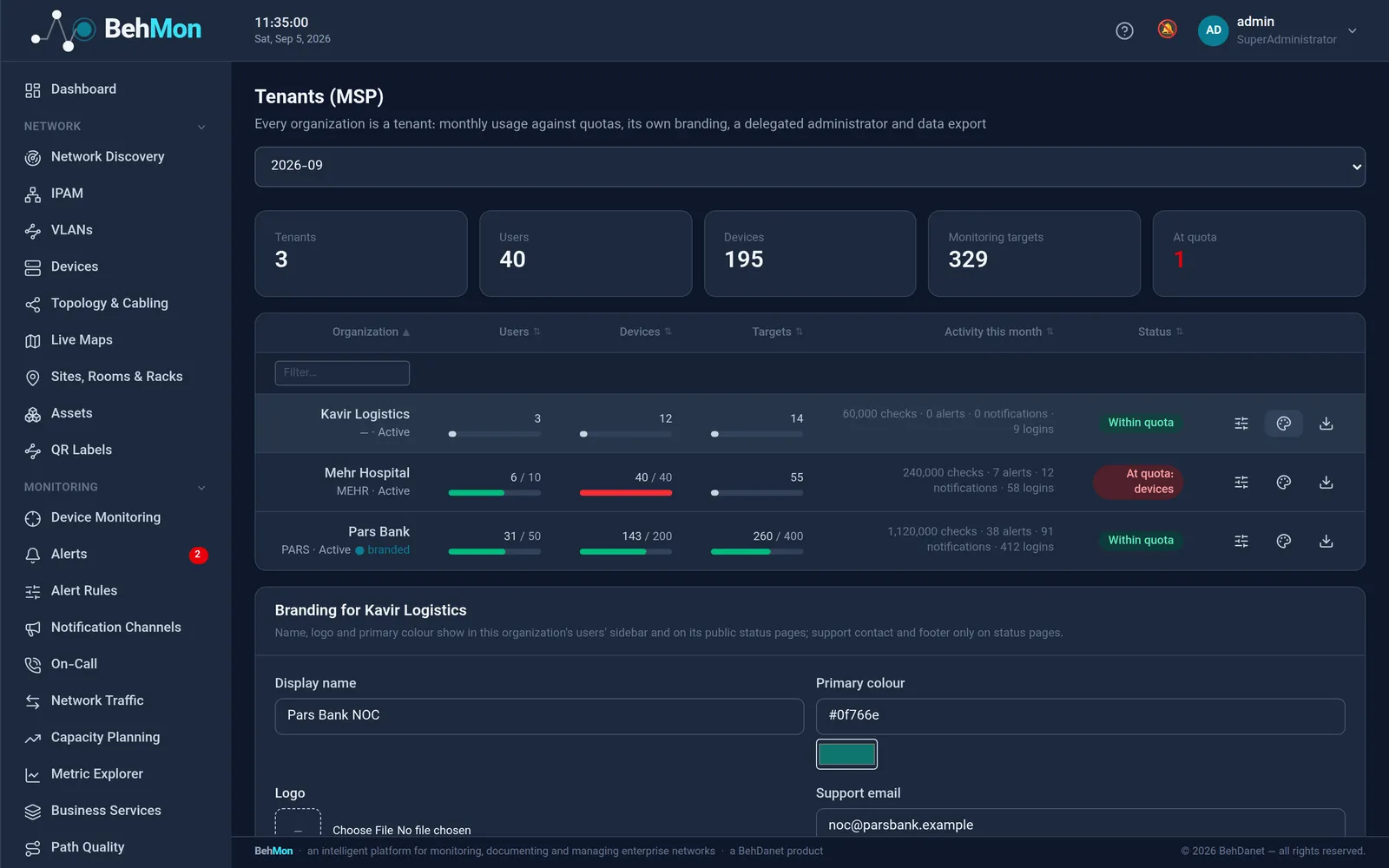
No. A customer holds an entirely separate role, and only the portal endpoints accept it — no operator endpoint answers to it. The portal also speaks deliberately about services rather than devices and addresses.
The status page is open to everyone and only says whether services are up. The portal is behind a sign-in and gives each customer their monthly report, their documents, their usage against quota, and a way to raise a request.
The customer portal and multi-tenancy are part of the Enterprise licence. See the licence page for details.
Real-time monitoring of devices, links and services with ICMP, SNMP and synthetic checks — and alerting without the noise.
Learn moreDevice inventory, racks and cabling, automatic topology, IPAM and QR labels — documentation that always matches the real network.
Learn moreAutomatic config backups, version diffs, compliance rules and four-eyes approval for every change.
Learn moreAn assistant that answers from your network's live data — and runs on your own server, with no internet.
Learn moreNetFlow/IPFIX, top talkers, traffic history and suspicious-behaviour detection — plus syslog and SNMP traps.
Learn moreRuns on your own servers, with MFA, LDAP and SSO, roles and permissions, full auditing, multi-tenancy and high availability.
Learn moreA documented API with a compatibility promise, two ready SDKs (Python and TypeScript), and signed webhooks for every event.
Learn moreBook an online demo, or install the 30-day trial on your own server. Our engineers will be right there with you.